

Color as a language
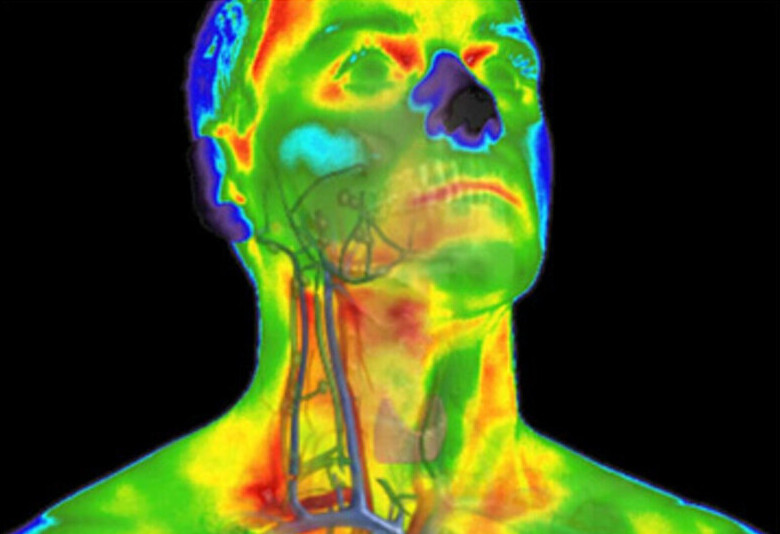
Warmer areas read as red, cooler as blue, with green where the temperature is more neutral. The image holds that contrast so you can see what the eye cannot.

Your journey to proactive wellness begins here. Safe, painless, no-contact infrared imaging across the Florida Keys: a window into your health, with a full written interpretation you can share with the practitioners you already trust.
What it is
What the skin can communicate
Your body gives off heat. A high-resolution camera records that heat from a few feet away as a thermal signature — a map of warmth across the surface of your skin.
Nothing touches you. It is safe and painless. The camera records physiological patterns, not anatomical structures.
A study is most useful over time, once a baseline is in place. Later images show how your patterns have changed, so you can review anything of interest with your practitioner.
The science
Your skin is the largest organ you have, and the only one you can read from the outside. Blood flow, inflammation and metabolic activity all influence its temperature, and the circulatory, nervous and hormonal systems beneath it leave their traces there.
You already read a little of this by eye — color rising in a face, the flush of exertion, the pallor of feeling unwell. Infrared imaging identifies thermal changes far below what the eye can pick up and renders them as color. A study describes how your body is working today, rather than mapping what it is built from.
Warmer areas read as red, cooler as blue, with green where the temperature is more neutral. The image holds that contrast so you can see what the eye cannot.
A first study is a starting point, not a conclusion. A baseline is usually made by comparing two studies a few months apart. After that, the value is in the change — whether a pattern is resolving, evolving, or unchanged.
Follow your thermal patterns across seasons and years. Each study leaves a written record you can return to.
Share your images and interpretation with the practitioners you already work with, so the conversation starts from more than symptoms.
A first study gives you something to compare. Image yearly, or more often, as it fits your care.
A way to notice how patterns change as lifestyle, nutrition, or the therapies you already use take effect.
Comprehensive
What temperature variations on the skin can communicate. If you are not sure what you need, say so when you call and we will work it out together.
A baseline for breast health awareness — how each side compares, and how that picture changes over time.
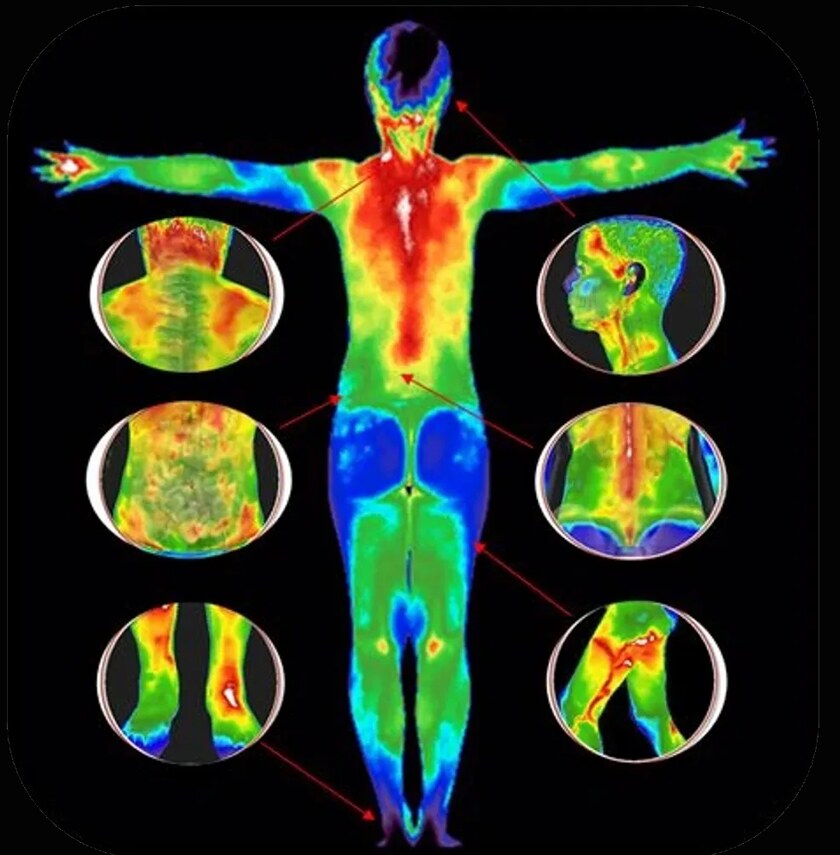
Pockets of heat in joints, muscle, or soft tissue that can mark irritation or recovery.
Cooler or uneven patterns along a limb or nerve path, useful when symptoms follow a line rather than a single spot.
Differences in warmth that can relate to circulation in the neck — including the carotid region — and in the arms or legs.
Shoulders, back, hips, and other structures under mechanical stress — where heat often gathers around strain.
Patterns near lymph pathways in the neck, underarms, chest, and groin.
The lower neck, where small shifts in heat can draw attention to how that region of the neck is presenting.
Shoulder to fingertips. Helpful for overuse, lingering injury, or temperature sensitivities.
From hip to toes. One side compared with the other. Often used when a leg or foot is cooler, warmer, or more symptomatic than the other.
The midsection. Patterns on the surface can point to digestive concerns.
Face, jaw, and teeth. Heat in this region can point to a quiet dental concern, and to its connection with the rest of the body.
The mid-face and brow. Patterns in this area are often reviewed with allergy history, congestion, or recurring sinus symptoms.
Asymmetry that can accompany persistent or regional pain, including complex patterns that do not follow a single joint.
Scattered or widespread differences that sometimes appear when the body is in a more systemic inflammatory state.
Studies & pricing
Every study includes a health history intake, a complete set of images, breast health education where relevant, and a full written interpretation by a specialized, board-certified physician.
Eight images from different angles map your unique temperature patterns — influences like thyroid function, lymphatic flow, and hormone balance can appear as variations. A non-invasive, contact-free way to support breast wellness, with breast health education included.
Adds the chest to the breast study — including the heart, lung area, and chest wall. Temperature patterns and their variations highlight what may be worth a closer look.
From the waist up: abdomen, chest, back, neck, and the areas of the heart, thyroid, carotid arteries, sinuses and teeth. For women the chest views include the breasts. Our most popular baseline study.
From head to toe, including the arms and legs — the most complete baseline study.
Maps temperature patterns of the teeth, jaw and face. Oral health is closely tied to the rest of the body, and this study can point to patterns worth reviewing with your dentist.
A single region of interest is $250, and two regions of interest (ROI) are $350. A discount program for frequent imaging is offered on request — call to learn more.
The imaging experience
A study runs between thirty and ninety minutes depending on what you are having imaged. You are in a private, temperature-controlled room throughout, behind a screen or curtain.
Call or write to choose a time and the study that fits what you want to look at.
You acclimate to the cool room while we go through a short health history. Images are then taken with a FLIR infrared camera. A privacy screen stays in place throughout.
Your images are read by a specialized, board-certified physician. Your emailed results include your images, a written interpretation report, and educational health guides. A discussion of the findings is available by request.
There is a short list of things to avoid before your study. They change your skin temperature and make the images harder to read. The full sheet is on the preparation page.
Afterwards
Your written interpretation describes your thermal patterns, notes anything worth raising with your healthcare team, and suggests when to return. It is written to be read by you as well as by a practitioner.
Thermography records patterns rather than structures, so a report is a starting point for conversation, not an answer on its own. That is why we encourage you to share the report with the practitioners you already work with, with a consultation available by request.
Most people return three months after their first breast study. For the full body study and the other health studies, once a year is the usual recommendation. Two sets of images establish what is normal for you — three months apart for the breast study, about a year apart for the others, or as often as your practitioner suggests if you are working on an issue. That is what every later study is measured against.
You may choose to image more often if you and your practitioners are tracking something, or working through a change in lifestyle, nutrition or therapy. Each study leaves a written record you can return to.
Meet your thermographer
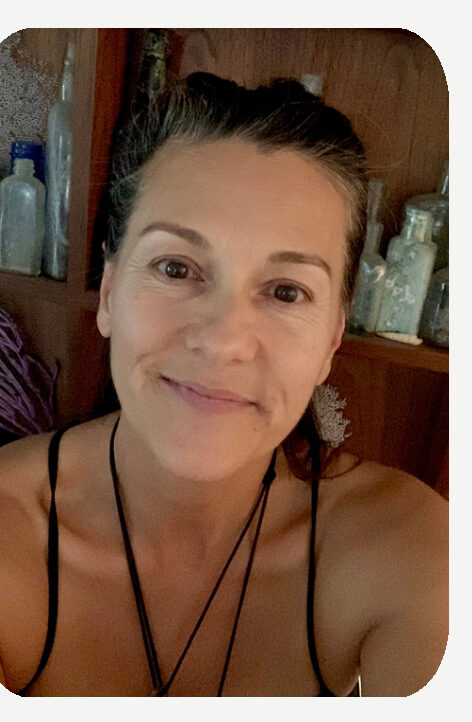
A thermographer and licensed esthetician, working in wellness since 2007. As a mother of two, she brings a holistic, client-centered approach to the Florida Keys community.
She is passionate about helping people take proactive steps toward wellness and make informed choices through education and self-awareness — which is why every study includes the time to sit down and understand what you are looking at.
“Looking forward to your health discovery journey.”Daniela
About the study
Yes. The camera is entirely passive — it receives the infrared heat your body already gives off and adds nothing to you. It is safe: nothing is sent into your body, there is no injection, and nothing touches you.
Because nothing is introduced, a study can be repeated as often as your care calls for, at any age.
No. Nothing touches you at any point. Most people describe a study as the most restful imaging appointment they have had. The longest part is simply resting while your skin settles.
None. The camera only measures the heat leaving the surface of your skin — nothing is sent into your body at any point.
Between thirty and ninety minutes depending on what you are having imaged. A breast study is around forty-five minutes; a full study with abdomen around sixty. Arrive fifteen minutes early for your intake.
Loose, comfortable clothing that is easy to remove. Put long hair up in a high bun. A gown and covering are provided, so there is no need to bring anything to keep warm — the imaging room is kept cool on purpose, and your body settles to it before any images are taken.
There is a short list of things to avoid beforehand, including lotions, deodorant and hot showers. The preparation sheet has all of it.
Yes. Thermal imaging records heat at the surface of the skin, so implants do not obstruct it and nothing presses on you. This is one of the reasons people choose to add thermography to their routine.
There is nothing about thermal imaging that is unsafe during pregnancy or nursing, since nothing is introduced to your body. That said, both change your thermal patterns considerably.
If you are nursing, we generally suggest waiting three months after weaning unless we are specifically looking at lactation. Call and we will talk through your timing.
No. There is no lower or upper age restriction, and no cumulative exposure to consider, so a study is available whenever it is useful to you.
Most people establish a baseline with two studies three to six months apart, then image annually. You may choose to come more often if you and your practitioners are tracking something specific, or working through a change in lifestyle, nutrition or therapy.
Your written interpretation always includes a recommended timeframe for your next study.
No. Thermography is an adjunctive imaging method. It is not a substitute for mammography, clinical examination, or other diagnostic tests.
The two look at genuinely different things: mammography records structure, thermal imaging records function and circulation. They answer different questions, and thermography is used alongside — never instead of — the imaging your physician recommends.
Your images are interpreted by a specialized, board-certified physician, not by us in the room. You receive their full written interpretation, and we will go through it with you by phone or Zoom.
Your report will note any thermal patterns worth discussing with your healthcare team, and recommend when to return. Thermography records patterns; it cannot tell you what is causing them, so the next step is always a conversation with your own practitioner.
We will make sure you understand what you are looking at, so that conversation starts from an informed place. Thermography is not intended to diagnose, treat, cure or prevent any disease.
Yes, and we encourage it. Say the word and we will send your images and written interpretation to any practitioner you name — that option is included with every study.
Practical matters
Thermography is generally not covered by insurance, and we do not bill insurers directly. Many clients submit their receipt and written interpretation to an HSA or FSA plan. Ask us for whatever documentation you need.
Your intake, images and written interpretation are health information and are treated as such. They are stored securely, and they are sent to another practitioner only when you ask us to.
Payment is due at the time of your study. Call ahead if you would like to confirm which methods we can take.
Your interpretation is prepared by a specialized, board-certified physician after your visit and sent to you in writing, along with a consultation to talk it through. We will give you a timeframe on the day.
Prepare for your session
There are a few things to avoid in the twenty-four hours before your study, and a few more in the four hours before you arrive: no lotions, no vigorous exercise, no hot or cold packs. We will send you the full sheet when you book.
Serving locations throughout the Keys, Key West to Key Largo.
Call or email [email protected].
Prefer to write? Send us your details and we will come back to you.